

The Hermetic Code: A Universal Science Hidden in Plain Sight

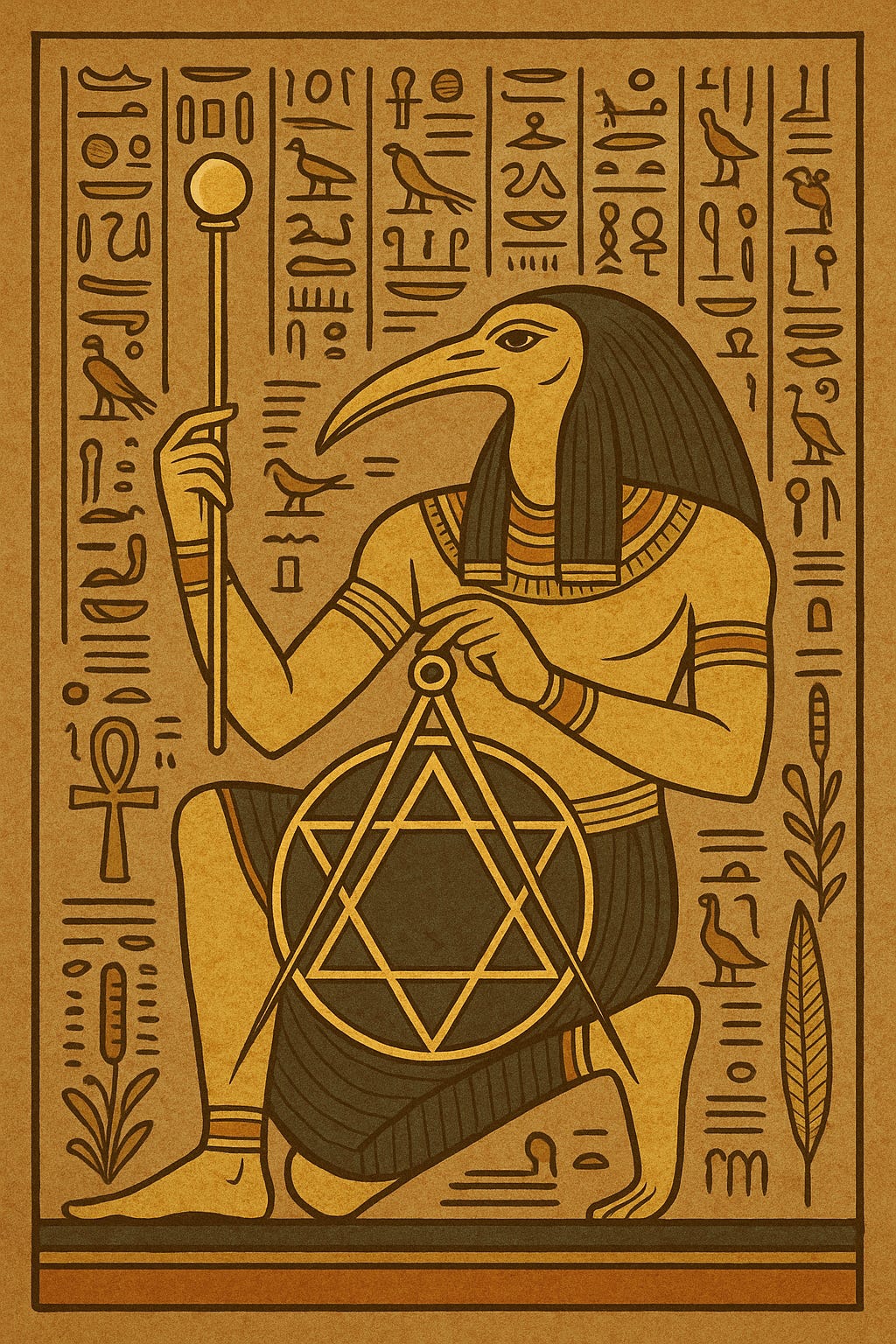
Twenty years ago, I found myself drawn to Freemasonry for reasons that had little to do with philosophy and much to do with inheritance. It was part of my family history, something men before me had held quietly, without spectacle. I felt a need to understand what it had meant to them. When I first encountered it, what struck me was not ritual, but atmosphere. There was a seriousness in the use of symbols and geometry that felt deliberate rather than theatrical. The symbolism did not feel religious, yet it was not opposed to religion either. It sat somewhere deeper, in a space that felt older than belief and older than doubt.
Over time, it became clear that Freemasonry was not the origin of what it carried, but one of its later vessels. It was a modern link in a very long chain of transmission.
Most people now encounter the Hermetic principles as fragments. A simplified list. A stylised chart. A sentence quoted without context. Presented this way, they can look mystical or ornamental. In their original form, they were neither.
They began as an attempt to describe reality in a way that could survive time, collapse, censorship, and cultural forgetting. The ambition was not spiritual comfort. It was structural accuracy.
The tradition that carried these ideas took shape in the intellectual world of Hellenistic Egypt and Greece in the early centuries of the common era, though it was consistently described within its own lineage as preserving teachings believed to be far older, transmitted orally long before they were committed to text. The teachings were attributed to Hermes Trismegistus, a symbolic figure combining aspects of Hermes and Thoth, both associated with writing, measurement, and knowledge. Hermes Trismegistus was not primarily a person. The name functioned as a signature for a lineage of thinkers who believed that reality was governed by order rather than accident.
These ideas were preserved in a body of writings now referred to as the Hermetica. They moved through Alexandria, where philosophy, mathematics, and cosmology were treated as a unified pursuit. When later religious and political systems narrowed the boundaries of acceptable thought, this knowledge was pushed out of public view. It was not destroyed. It was kept alive quietly, through scholarly traditions in Byzantium, Islamic philosophy, and European monastic scriptoria.
During the Renaissance, these texts re-entered the European intellectual bloodstream. The translation of the Corpus Hermeticum into Latin deeply influenced early modern thinkers. Figures like Bruno, Paracelsus, Kepler, and Newton did not see these teachings as superstition.
They saw them as serious attempts to describe the structure of reality. What we now call modern science did not arise in opposition to this legacy. It grew through it.
As intellectual life hardened under religious and political pressures, the method of transmission changed again. Knowledge that could not be taught openly moved into symbolic form. Freemasonry became one of the structures that carried it forward. Early Freemasonry did not function as a political movement. It acted as a cultural memory system. Its symbols encoded ideas that were considered too subtle or too dangerous to preserve in plain language. Geometric forms replaced theological declarations. Tools of building became ways of thinking about order. The Temple of Solomon became a conceptual model of a universe governed by proportion rather than dogma. This was not concealment for power. It was preservation for continuity.
What survived across these transitions became known, much later, as the Hermetic principles. These were never meant to be commandments. They describe how reality behaves.
The principle of Mentalism, often phrased as “the All is Mind,” is not about fantasy or belief. It reflects the idea that reality is structured by intelligibility rather than randomness. Modern physics increasingly supports this view. Information is treated as a physical quantity. Systems are described in terms of coherence and probability rather than solid absolutes. The Hermetic idea of “Mind” aligns closely with what science now recognises as the informational structure of reality.
The principle of Correspondence does not claim poetic resemblance. It describes structural repetition. The same patterns appear in storms, cells, nervous systems, markets, and civilisations. This is now captured mathematically through concepts such as scale invariance and fractal organisation. Cities resemble organisms not because we imagine it, but because the same constraints shape them.
The principle of Vibration is no longer metaphorical. Matter is not static. It exists as patterns of movement within fields. Time carries rhythms as well. Living systems, economic systems, and cultures all oscillate. When these rhythms drift out of alignment, stability degrades. What older language called harmony now maps directly onto synchronisation.
Polarity is not about moral opposition. It describes gradients. Heat and cold occupy a single continuum. Growth and decay occur within the same energetic system. Without difference, no work can be done. Civilisations often fail not because of ethical failure, but because the tension that once made them dynamic becomes either rigid or chaotic.
Rhythm applies this logic to history itself. Large systems do not move smoothly. They pulse. They compress and expand. They centralise and fragment. These patterns are not stories we tell after the fact. They have measurable structure, which modern complexity science increasingly models.
Cause and Effect, in this framework, is not naive determinism. It is structural causation. Systems are nonlinear. Small inputs can cascade. Delay can destabilise. Feedback can dominate. The limits of prediction arise not from chaos, but from depth of structure.
The principle sometimes called Gender is not biological. It refers to complementarity. The relationship between movement and constraint, force and form. When movement overwhelms form, systems fracture. When form suppresses movement, systems stagnate. Meaningful stability emerges only in balance.
This is not mysticism. It is better understood as an early form of structural science, compressed into a format capable of surviving long periods of cultural instability and intellectual darkness. The aim was never to create belief systems or found new religions, but to preserve accurate descriptions of how reality behaves in a form that could outlast empires, orthodoxies, and ideological capture. Hermeticism was never designed to be worshipped. It does not ask for faith, nor does it promise salvation. It functions instead as a substrate: a set of structural insights that can sit beneath any religion or scientific framework without competing with them. This is precisely why it remains compatible with Christianity, Islam, Buddhism, Hindu philosophy, and modern physics.
It does not replace these systems; it describes the architecture within which they arise.
Because of this, it resists ideology in a way most belief systems cannot. Political and religious power structures rely on symbols of authority, identity, and loyalty. Hermetic thought offers none of these. It has no hierarchy of power, no centre of command, and no mechanism for capture. What it preserves is structure rather than status, pattern rather than position. That is why it continues to reappear across history, even when suppressed, diluted, or misrepresented. It carries no banner and therefore cannot be conquered.
For most of human history, none of these ideas could be tested. There were no instruments capable of measuring coherence, informational density, systemic tempo, or structural instability. The principles endured not because they were fashionable or comforting, but because they remained functionally accurate. They survived as a form of compressed intelligence, waiting for a civilisation capable of measuring what earlier thinkers could only intuit.
That civilisation now exists. Modern thermodynamics, information theory, systems biology, and complexity science are beginning to describe, with mathematical precision, the same destabilising thresholds that the Hermetic tradition preserved symbolically. We can now observe systems failing when complexity outpaces energy, organisms collapsing when coherence breaks down, and economic systems destabilising when internal tempo drifts too far from capacity. Even artificial systems exhibit similar failure modes when alignment degrades. These are no longer philosophical claims. They are measurable processes.
What we are witnessing is not a revival of ancient mysticism, but the gradual recovery of a structural science that civilisation once abandoned. The original thinkers were not mystics escaping from reality. They were engineers of intelligibility, attempting to design a form of knowledge that could travel through time without being captured by power, distorted by ideology, or destroyed by collapse.
They were not trying to build belief. They were trying to preserve structure itself.
The only open question now is not whether they were right. It is whether we have finally developed the intellectual maturity to understand what they were trying to give us.
If these ideas stayed with you, you’re invited to follow where they lead.
—Joseph
Hello there Joseph, I hope you are well friend.
I’ve been seeing your notes for a while now, always thought provoking, thank you.
I thought you may enjoy what I talk about, I take a different approach to history, focusing on obscure historic books.
https://open.substack.com/pub/jordannuttall/p/15th-century-alchemical-healing