

David Hackworth - The Warrior the Machine Couldn’t Tolerate

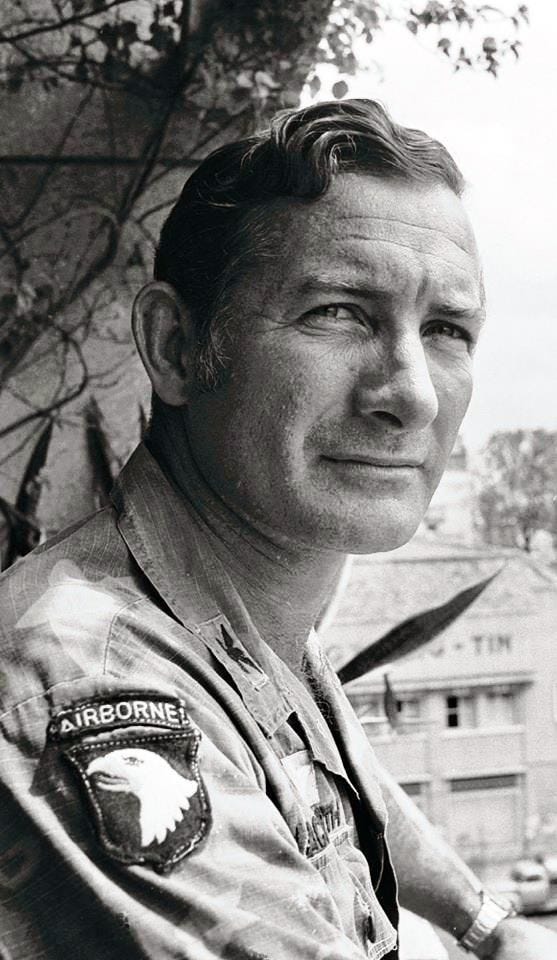
Colonel David Hackworth, Vietnam War.
Some men are made for peace. They can build careers. They can sit through meetings. They can rise through institutions with patience, tact, and political instinct. They can tolerate the slow compromises that come with stable systems and still believe the system is fundamentally healthy. They can play the game without losing themselves.
David Hackworth was not that kind of man.
Hackworth belonged to an older breed, the kind civilisation produces in small numbers and then struggles to accommodate once the shooting stops. He was forged in the most direct way possible: by war itself. Not war as abstraction or policy, but war as mud, fear, exhaustion, and moral gravity, where the world reduces to first principles and pretence is punished immediately. He joined the United States Army at fifteen, grew into a man inside combat, and became something rare even among infantry officers: a battlefield leader whose presence seemed to alter the emotional temperature of the unit around him.
The Army claims it wants men like that. Every institution says it does. Yet what institutions often want, in practice, is not raw excellence but manageable excellence.
Excellence that flatters the hierarchy. Excellence that doesn’t disrupt the story. Excellence that can be folded neatly into the system without forcing the system to confront itself.
Hackworth didn’t fold.
In a sense, his story begins before Korea, in the long grey interval after World War II when the world was trying to return to normality and the Army was doing what armies do in peacetime: waiting. In Trieste, in those formative post-war years, Hackworth fell under the influence of the man he would always look up to from that point forward. Not a general. Not an officer. A sergeant. Steve Prazenka, a hard, training-focused platoon sergeant who over five years imprinted something permanent into the young Hackworth’s nervous system: what leadership looks like when it’s real, what standards feel like when they’re lived, and what competence looks like when it’s demanded rather than talked about.
That early imprint mattered because it anchored him in the true lineage of armies, the sergeant’s war, the NCO tradition where authority isn’t granted by credential but earned through effectiveness, consistency, and moral seriousness. Before Hackworth was a famous officer, before he was decorated beyond belief, his internal compass had already been calibrated not by headquarters culture but by the NCO line.
He absorbed the truth that every serious soldier eventually learns: the Army’s moral centre doesn’t live in organisational charts. It lives in the men who take boys and turn them into disciplined soldiers capable of surviving chaos.
Hackworth lied about his age to enlist. That detail matters not because it’s colourful but because it reveals the orientation of his soul. This wasn’t a man reluctantly drawn into conflict by circumstance. This was someone who moved toward the proving ground, as though he needed the edge to breathe. There are young men who dream of battlefield glory and then grow out of it. Hackworth didn’t grow out of it because he didn’t merely want glory. He wanted the test. He wanted to find out who he was where consequences are real and courage is not theoretical.
Then Korea happened, and Korea did what war always does to young men. It strips away fantasy and leaves only truth. If you survive you either become bitter, or broken, or wise. If you’re very rare, you become effective in a way that changes the people around you.
Hackworth didn’t simply survive Korea. He became a phenomenon inside it.
War has its own brutal meritocracy. When bullets are real, competence becomes sacred. The men who can move under fire, think under pressure, take risks without gambling, and bring others through alive are noticed quickly. War colleges can teach doctrine. They cannot teach the thing war teaches, which is decision under fear, judgement under uncertainty, and leadership under the sickening awareness that you might send someone forward who won’t come back. That isn’t a skill set. It’s a moral burden.
In Korea, Hackworth carried it. He became a hardened sergeant and, astonishingly young, earned a battlefield commission. That is not a minor footnote. It is the institution, under the pressure of reality, telling the truth about who matters. By the time he left Korea he was already decorated for repeated heroism, and the medals themselves, while staggering, matter less than what they imply about the internal architecture required to earn them. You don’t win multiple Silver Stars by being clever. You win them by doing something that would normally get you killed and doing it anyway because in that moment you believe others matter more than you. Do it once and it’s extraordinary. Do it repeatedly and it becomes something else, a signature.
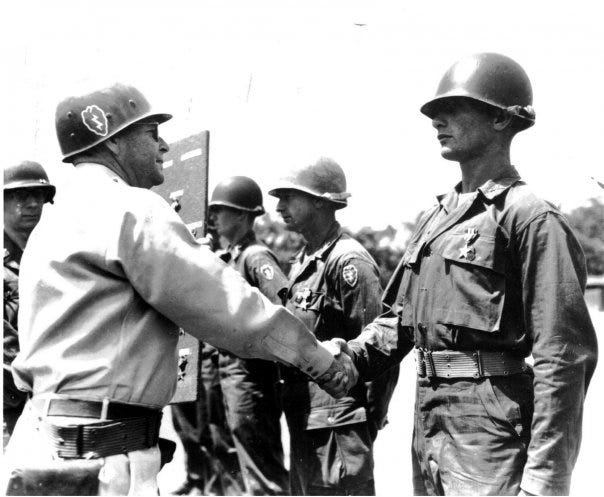
20-year-old Sergeant David Hackworth receiving a battlefield commission and the Silver Star in Korea (1951).
Korea initiated him. It gave him war’s strange gift: clarity. It made him serious early. It also created the conditions for the great tension of his life, because there are really two armies. There is the war Army, which lives close to reality and is forced to respect it, and there is the peace Army, which drifts toward bureaucracy, ritual, and career ecology. Both are necessary. Large forces can’t function without systems. But the two armies are never fully aligned, and the most dangerous moments in military history often arrive when the peacetime institution begins to dominate the warfighting culture, when the organisation starts rewarding the management of the organisation more than the mastery of war.
Hackworth was a problem for that world from the beginning. He could be insubordinate without technically being insubordinate. He could do what every commander secretly wants and fears at the same time: he could make a unit sharper, more disciplined, more lethal, more alive, but in doing so he exposed mediocrity. He exposed timid leadership.
He exposed the fact that some officers were more invested in career safety than in serious warfighting excellence. That kind of exposure creates enemies even if you never say a word, because your existence becomes contrast.
And yet he wasn’t crushed early, the way some truth-tellers are. For a long time he was protected. Certain commanding officers hated him, but senior combat leaders recognised what they were looking at and shielded him because they understood the difference between “difficult” and “necessary”. Mid-level career ecologies punish friction. Upper ranks who have seen war sometimes tolerate it because war doesn’t care about politeness. War demands reality.
His lineage deepened in Germany. During a Cold War posting he served under Colonel Glover S. Johns Jr., the Normandy veteran and author of The Clay Pigeons of St. Lô, a memoir written with the brutal clarity that only the initiated can produce. Hackworth regarded Johns as the best officer in the Army, and Johns took a special interest in Hackworth’s development. Excellence recognised excellence. War-truth reached forward through peace and placed its hand on the shoulder of the next generation. Hackworth was not simply a gifted outlier. He was an inheritor.
He was also never alone. Truly exceptional combat leaders create gravity. They don’t just perform well; they reorganise the social ecosystem around them. They attract similarly hard officers and serious SNCOs, people who don’t need theatre and don’t want organisational comfort, people who want to do the job properly and hate waste. Hackworth repelled polished careerists but drew in the warrior cohort, men whose credibility is earned in the oldest currency: risk, pain, loss, endurance. Some of his friends and peers would win the highest decorations the profession can confer, including Medals of Honour and Distinguished Service Crosses. Hackworth wasn’t a lone wolf. He was a node in a subculture, a pocket of the real Army inside the larger institution, a counter-elite organised around standards rather than ambition.
Then came Vietnam.
Vietnam wasn’t merely another war. It was another kind of war. Korea, for all its brutality, still carried the strategic geometry of industrial combat. Vietnam dissolved into politics, legitimacy, narrative, and shadow. It was war fought across the surface of a society, with meaning as decisive terrain. It was also war prosecuted by a system that increasingly substituted metrics for truth.
Hackworth served three tours in Vietnam, but his extraordinary record of decorations was forged across both Korea and Vietnam: two Distinguished Service Crosses, nine Silver Stars, eight Purple Hearts, a Distinguished Flying Cross, multiple Legion of Merit awards, and key foreign decorations including the Republic of Vietnam Gallantry Cross.
The ribbon rack is not the point, but it signals something important. By rank and role he didn’t have to keep finding the decisive ground. He didn’t have to keep being in the thick of it. Yet again and again he ended up where uncertainty peaked, where things were breaking, where units were pinned, where leadership was required in the oldest sense. People looked to him at the critical moment and he acted, not because the chain of command demanded it, but because the battlefield itself demands it. War has a way of finding those it can lean on.
By Vietnam, Hackworth was a living legend inside the Army. Not merely respected, but mythologised. There was a sense around him that he was unkillable, not in the childish sense but in the soldier’s sense: the man who always seemed to be where it was worst and still came out standing, the man who made contact feel survivable because he could see his way through it. That kind of legend is not vanity. It is operational. It changes the morale geometry of a unit. Men begin to feel bulletproof, not because they believe bullets won’t hit them, but because they believe they won’t be wasted, won’t be abandoned, won’t be led blindly into stupidity. They borrow certainty from the leader they trust, and in war that borrowed certainty becomes combat power.
Hackworth compounded that psychological advantage with another quality that made him almost impossible for peacetime culture to tolerate. He had contempt for stupid rules. Not discipline, not standards, not soldiering, but the petty, comfort-denying bureaucratic nonsense that mistakes deprivation for virtue and paperwork for professionalism. He spent his career pushing limits and leading like a maverick, not because he was reckless, but because he couldn’t tolerate institutional stupidity when lives were on the line. Even in Korea his Rangers “acquired” what they needed to live and fight with comfort and effectiveness. They stole gear, food, anything that made soldiering more sustainable, not as criminals but as predators inside scarcity.
Hackworth didn’t shut it down. He understood something the peace Army forgets: ingenuity is combat power. A leader who gives his men permission to out-think the system creates a unit that feels alive.
In Vietnam he carried the same ethos. He didn’t simply want men who obeyed. He wanted men who could improvise, adapt, steal time back from chaos, and win. Under Hackworth, soldiering wasn’t a set of rules. It was a craft. The craft demanded minds sharp enough to bend reality, not merely follow it.
Yet Vietnam also revealed something darker to him, something tactical brilliance could not solve. Hackworth could win fights and still feel the enterprise drifting. He could lead men brilliantly and still sense that the war itself was strategically incoherent. He could see the difference between what was happening and what was being said. He could see young men being consumed inside a conflict whose centre of gravity was being misread, where legitimacy and narrative were decisive and yet the machinery of war remained obsessed with kinetic outputs and briefable progress. This is the cruel irony of tactical excellence inside an incoherent war. The better you are, the more clearly you perceive that tactical success doesn’t necessarily resolve anything.
This is what made Hackworth uniquely dangerous to the machine. Not only his battlefield record, but the fact the highest leaders knew exactly what he was. General Creighton Abrams described him as “the best battalion commander I ever saw in the United States Army.” And Hackworth wasn’t only known at the tactical edge; he was known upward. Even Westmoreland sought his ground-truth views on the fighting. Hackworth didn’t speak in doctrine. He spoke in reality. That positioned him in a rare place in any hierarchy: admired by the men, recognised by the top, and therefore capable of threatening narrative control with credibility.
It’s worth setting the scene properly for the moment he chose to speak. By then he wasn’t just another disgruntled officer. He was one of the youngest colonels in the Army, a living legend inside the ranks, already one of the most decorated soldiers of his generation, the kind of officer whose name carried weight before he even entered a room. In any normal career arc, the trajectory was almost predetermined.
Men like that don’t stall. They’re groomed. They’re advanced. They’re placed into the stream that produces generals. Hackworth had the profile of a future flag officer, very likely two stars at minimum and, in another universe, probably three.
Which is what makes the interview so extraordinary.
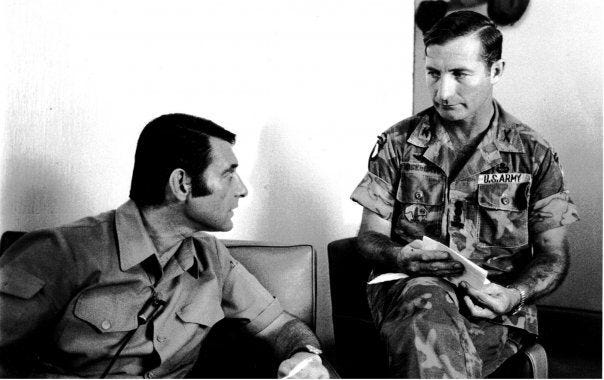
In his 1971 ABC interview, Hackworth stepped beyond the chain of command to confront what he saw as a widening gap between battlefield reality and institutional narrative… a moment that would cost him his future in uniform.
When he spoke out publicly on a national television interview against the war and against senior leadership, he wasn’t doing it from the margins. He was doing it from the inside, from near the top of the professional pyramid, fully aware that he was detonating his own career. He knew the machine well enough to know what it does to men who threaten narrative control, and he spoke anyway.
This wasn’t naïveté. It wasn’t impulsiveness. It was a deliberate choice to exchange institutional ascent for truth.
Modern military institutions can tolerate dissent only in certain forms. They can tolerate private critique. They can tolerate carefully worded concerns. They can tolerate disagreement that still affirms the theatre of unity. What they struggle to tolerate is truth spoken in public by someone whose credibility is too heavy to dismiss. It breaks narrative control. It forces civilians to see what the institution is doing rather than what it says it is doing.
So the machine responded like a machine.
Containment. Pressure. Isolation. Investigations. Career damage. Not necessarily because his critique was wrong, but because the act of speaking threatened institutional legitimacy. Bureaucracies interpret legitimacy as a resource that must be defended at all costs. In a healthy strategic culture, a man like Hackworth triggers reflection. In a bureaucratic culture, he triggers punishment.
This is what makes Hackworth mythic. The decorations alone don’t make him important. The choice makes him important. Loyalty to truth over loyalty to organisational survival. Loyalty to the profession over loyalty to the institution. Loyalty to warfighters over loyalty to career machinery. Hackworth didn’t turn against the Army in the shallow sense. He turned against the drift of the Army toward self-deception. He refused to allow courage to be used as moral cover for strategic incoherence.
For men like Hackworth, the war itself is not always the hardest part. War is horrific, but it is clarifying. It forces honesty. It punishes pretence. Peace is where things become unbearable. Peace is where the soldier returns to a world that feels flat, where language no longer points to consequences, where meetings replace mission, where the institution thanks the warrior and then quietly asks him to shut up because the presence of war makes everyone else uncomfortable.
For the war-made psyche, peace can feel like suffocation, not because it lacks comfort, but because it lacks meaning.
Hackworth’s return to the United States carried that weight. The peacetime Army, in particular, was hell for him. It rewarded caution. It rewarded polish. It rewarded those who could navigate politics while pretending politics didn’t exist. What it punished, quietly and efficiently, was the very thing it would later beg for in crisis: warfighting seriousness and strategic honesty.
This is where his book becomes central. If you want to understand Hackworth properly, you have to read About Face: The Odyssey of an American Warrior. It is not merely a memoir. It is one of the great leadership texts of the modern profession of arms, written with raw detail and kinetic intensity that reads like fiction, except the point is that it isn’t. It is battlefield glory told without sanitisation. It is also institutional indictment delivered without apology. In a sense, it is the continuation of his war, carried into language. Hackworth couldn’t fight the drift in uniform forever, but he could fight it in public, in writing, by refusing to let the institution bury truth under narrative.
Most men compromise, not because they are weak, but because they have families, responsibilities, futures. Hackworth didn’t compromise well. That failure, if we’re honest, is part of what made him special. He couldn’t soften. He couldn’t stop seeing too clearly.
Vietnam had shown him the machine could keep moving without truth, and peace showed him something darker: the machine would keep rewarding the personalities most compatible with that untruth.
Hackworth became a public conscience for warfighters because he couldn’t carry that recognition alone. He spoke about leadership, betrayal, the distance between generals and grunts, the moral injury of being spent in conflicts that cannot be described honestly. In doing so, he performed one of the most important functions in any profession: he defended the craft’s soul against institutional drift. He defended the war Army inside the peace Army.
So what do we do with a man like Hackworth?
Modern societies turn men like this into symbols, admire them, quote them, then move on. But Hackworth resists sanitisation. His life demands to be taken seriously as warning. It asks whether the profession still has the courage to speak strategic truth.
It asks whether the institution still knows how to recognise genius when it arrives in a form that disrupts comfort. It asks whether we have learned the real lesson of Vietnam, not in capability, but in honesty.
Hackworth was not flawless. No warrior like this is. But he possessed a form of integrity rare in any era: the willingness to tell the truth when truth threatens the system, and the willingness to accept exile rather than collusion. He didn’t just fight the enemy. He fought the drift.
And if the West ever wants to truly integrate Vietnam, it will need more Hackworths, not fewer.
Because sooner or later reality returns. And when it does, it doesn’t ask how polished the institution is. It asks whether it can still think, whether it can still lead, and whether it can still tell the truth.
If you found this valuable, you can tap “like” in the Substack app, as it helps more people discover the essay.

Hi Dan - I really appreciate the feedback. Given your background I understand why this one has resonated with you.
Another fantastic article Joe, thank you